Share Incentive Plan
Calculator
Estimate the future value of your equity compensation including RSUs, Stock Options, and ESOPs. Account for taxes and compound growth instantly.
Equity Details
Growth Projection
Your Results Appear Here
Fill in your equity details and click Calculate Now to see projections.
| Year | Vested Shares | Share Price | Pre-Tax Value | Net After Tax |
|---|
⚡ Quick Answer: What Is a Share Incentive Plan Calculator?
A Share Incentive Plan Calculator estimates the future after-tax value of your equity compensation — including RSUs, stock options, and ESPP. Enter your share price, number of shares, vesting schedule, growth rate, and tax rate. The tool instantly shows your pre-tax value, estimated tax owed, and final take-home amount year by year.
Related Calculators
Tax CalculatorsTable of Contents
Share Incentive Plan Calculator: Estimate Your True Equity Value (2026)
Your company just handed you an equity offer RSUs, stock options, maybe an ESPP and now you’re staring at a grant agreement that reads like a legal document written in a foreign language. You know the numbers look big. But what do they actually mean for your financial future?
Here’s the thing: most American employees leave significant money on the table every year simply because they don’t understand what their equity is worth right now or what it could be worth in three to five years. A Share Incentive Plan Calculator cuts through that confusion fast. It takes your vesting schedule, current share price, tax bracket, and growth assumptions, then shows real dollar projections before and after tax.
Let me explain exactly how to use this tool, what each result actually means, and the mistakes to avoid so users can make smarter decisions about one of the most valuable parts of their total compensation.
Equity Award Types at a Glance
| Award Type | What You Receive | Upfront Cost | When Tax Hits | Best Suited For |
|---|---|---|---|---|
| RSU | Actual shares after vesting | $0 | At vesting (ordinary income) | Public company employees |
| ISO | Right to buy at strike price | Strike price | At sale (possible AMT) | Early-stage startup employees |
| NSO | Right to buy at strike price | Strike price | At exercise (ordinary income) | Contractors, advisors |
| ESPP | Discounted company shares | Payroll deduction | At sale (holding period matters) | All public company employees |
| Performance Shares | Shares tied to company metrics | $0 | At vesting (ordinary income) | Senior executives, VPs |

What Is a Share Incentive Plan & What Does It Do?
A Share Incentive Plan (SIP) is a structured employee benefit program that lets workers acquire ownership stakes in the company they work for typically through RSUs (Restricted Stock Units), stock options, ESPPs (Employee Stock Purchase Plans), or performance shares. These equity awards form a growing piece of total compensation at tech companies, financial firms, and Fortune 500 corporations across the United States.
The problem employees face isn’t the plan itself it’s the math. Stock prices move. Tax brackets shift. Vesting schedules stretch across four years. Without a reliable Share Incentive Plan Calculator, it’s nearly impossible to know whether that $50,000 RSU grant is actually worth $32,000 after federal income tax and state withholding or significantly more if the stock grows at 8% annually.
Think of it this way: a Share Incentive Plan Calculator is the financial GPS employees never knew they needed. It transforms a confusing equity grant document into a clear year-by-year projection of real, spendable dollars. Whether someone is an engineer at a startup in Austin, Texas, or a manager at a public company in Seattle, Washington, this tool helps them understand exactly what they’ve earned and what they’ll owe to the IRS when shares vest.
Key entities this tool covers:
- RSUs (Restricted Stock Units) — actual company shares delivered after vesting conditions are met
- Stock Options — the right to purchase shares at a fixed strike price
- ESPPs — employer-sponsored plans allowing purchase of company stock at a discount (typically up to 15% off)
- Performance Shares — equity tied to specific company metrics like revenue growth or total shareholder return
- Vesting Schedule — the timeline over which equity awards are earned
How Is RSU Value Calculated?
The standard RSU calculation formula is:
Projected Price = Current Price × (1 + Growth Rate)^Years
Example: 500 shares × $108 projected price × (1 – 0.30 tax rate) = $37,800 after-tax in Year 1.
How to Calculate Stock Option Value — Quick Steps
- Enter the current share price
- Enter the strike price (price you can buy shares at)
- Subtract strike price from current price — this is your intrinsic value per share
- Multiply by number of options vested
- Subtract your tax rate to get after-tax value
- Apply annual growth rate for future projections
How to Use the Share Incentive Plan Calculator
Using this tool takes less than two minutes. Here’s exactly how to get the most accurate projections:
Step 1 – Select Your Equity Type
Choose between RSUs, stock options (ISO or NSO), ESPP, or performance shares. Each type uses a different formula, so picking the right one is critical.
Step 2 – Enter the Current Share Price
This is the stock’s current fair market value (FMV). For public companies, users can check this in real time on any financial platform. For private companies, this figure appears in the company’s most recent 409A valuation.
Step 3 — Input the Number of Shares Granted
Enter the total grant size for example, 1,000 RSUs or 500 stock options. This number appears on the equity grant agreement users signed at hire or during an annual review.
What Is a 4-Year Vesting Schedule With 1-Year Cliff?
A 4-year vesting schedule with a 1-year cliff means no shares vest in the first 12 months. After the 1-year cliff, 25% of total shares vest at once. The remaining 75% then vest monthly or quarterly over the next 3 years. If an employee leaves before the cliff date, they receive zero shares.
| Year | Shares Vested | Cumulative Total |
|---|---|---|
| Year 1 (Cliff) | 25% | 25% |
| Year 2 | 25% | 50% |
| Year 3 | 25% | 75% |
| Year 4 | 25% | 100% |
Step 4 — Enter the Vesting Schedule
Most US companies use a 4-year vesting schedule with a 1-year cliff. A 25%/25%/25%/25% structure means 25% of shares vest each year. Some companies vest monthly after the cliff. Enter whatever the grant document specifies.
Step 5 — Set the Annual Growth Rate
This is an estimate of how much the company’s stock might grow annually. Conservative: 5%. Moderate: 8-10%. Aggressive: 15%+. The tool will run projections for each scenario.
Step 6 — Enter the Tax Rate
For most US employees, the federal withholding rate on RSU vesting is 22% (supplemental wage rate). Higher earners in the 32%-37% bracket will owe more at tax time. Add state income tax if applicable — California employees, for example, pay up to 13.3% state tax on top of federal.
Step 7 — Click Calculate
The calculator instantly outputs year-by-year pre-tax value, post-tax value, and a cumulative total, often shown as a bar chart or table.
Long Term Incentive Calculator
Estimate your LTI payout & vesting value — free tool
Worked Example: Software Engineer in San Francisco, CA
Say a software engineer receives the following equity package at a public tech company:
- RSU Grant: 800 shares
- Current Share Price: $100
- Vesting Schedule: 4 years, 25% per year (200 shares/year)
- Annual Growth Rate: 8%
- Marginal Tax Rate: 32% federal + 9.3% California state = ~41.3% total
Here’s what the projection looks like:
| Year | Shares Vesting | Projected Share Price | Pre-Tax Value | After-Tax Value |
|---|---|---|---|---|
| Year 1 | 200 | $108.00 | $21,600 | $12,701 |
| Year 2 | 200 | $116.64 | $23,328 | $13,716 |
| Year 3 | 200 | $125.97 | $25,194 | $14,814 |
| Year 4 | 200 | $136.05 | $27,210 | $15,998 |
| Total | 800 | — | $97,332 | $57,229 |
Formula used: Projected Price = Current Price × (1 + Growth Rate)^Years | After-Tax Value = Pre-Tax Value × (1 – Total Tax Rate)
That’s a real-world projection this engineer can actually use to plan retirement contributions, mortgage payments, or investment decisions. A Share Incentive Plan Calculator makes that clarity instant.
Understanding Your Results
RSU Tax Rate by State 2026 — Complete Breakdown
RSU tax rates vary significantly by state in 2026. Federal withholding is 22% for all employees. State tax is added on top — ranging from 0% in Texas and Florida to 13.3% in California. High earners may also owe the 3.8% Net Investment Income Tax and 0.9% Additional Medicare Tax.
Once the calculation runs, three outputs matter most:
Pre-Tax Vesting Value:
The gross dollar value of shares at the moment they vest. This is what hits the W-2 as ordinary income for RSUs.
Post-Tax Value:
What actually lands in the employee’s pocket after federal withholding, state tax, Social Security (up to the wage base), and Medicare (including the 0.9% Additional Medicare Tax for high earners). This number is always the one to plan around.
Cumulative Projection:
The total equity value employees can expect to receive over the entire vesting period, assuming the entered growth rate. This is the number that answers: “Is this offer actually competitive?”
What Does a Good Result Look Like?
For most US tech employees, equity compensation that represents 20-40% of total annual base salary in vested value per year is considered strong. A result significantly below that — especially at a well-funded company — may signal a below-market offer worth negotiating.
For stock options specifically, a result showing the options are “in the money” (projected share price above strike price) means the grant has intrinsic value. Options showing a projected value near zero likely need a much higher growth assumption to generate returns — which is a risk factor worth considering.
RSU vs Stock Options vs ESPP — Key Differences
| Feature | RSU | Stock Options | ESPP |
|---|---|---|---|
| Upfront Cost | $0 | Strike Price | Payroll Deduction |
| Value Floor | Always positive | Can be $0 | Guaranteed discount |
| Tax Trigger | At vesting | At exercise | At sale |
| Best For | Stable companies | High growth startups | All public employees |
| Risk Level | Low | High | Very Low |
RSUs vs. Stock Options vs. ESPP: A Side-by-Side Comparison
One of the most common reasons employees turn to compare equity types. Here’s a clear breakdown of how RSUs, stock options, and ESPPs differ in terms of risk, tax treatment, and payout mechanics , For a deeper breakdown of how each equity type is structured, the National Center for Employee Ownership (NCEO) provides one of the most comprehensive non-commercial guides available.”
| Feature | RSUs | Stock Options (ISO/NSO) | ESPP |
|---|---|---|---|
| Upfront Cost | $0 | $0 to grant; exercise price to exercise | Payroll deductions (1-15% of salary) |
| Value Floor | Always > $0 if stock exists | Can expire worthless | Guaranteed discount (up to 15%) |
| Tax Trigger | At vesting (ordinary income) | At exercise (NSO = ordinary income; ISO = potential AMT) | At sale (depends on holding period) |
| Best For | Risk-averse employees, public companies | High-growth startups, risk-tolerant employees | All employees at public companies |
| Annual IRS Limit | N/A | $100,000 ISO limit per year | $25,000 cap per year |
| Vesting Required | Yes | Yes | No vesting; purchase periods (typically 6 months) |
RSU vs Salary — Which Is Better?
Salary is better if you need immediate, guaranteed income. RSUs are better if the company stock is likely to grow and you can wait 1–4 years for vesting. Most financial advisors recommend accepting RSUs when the company is public, stable, and growing — because RSUs always retain value above zero unlike stock options.
| Factor | Salary | RSU |
|---|---|---|
| Guaranteed? | ✅ Yes | ⚠️ Depends on stock |
| Tax Timing | Monthly | At vesting |
| Upside Potential | Fixed | Unlimited |
| Best For | Immediate needs | Long-term wealth |
| Risk | None | Stock price risk |
The RSU vs. Options Decision
Think of it this way: RSUs are the safer bet. They always retain value as long as the stock price is above zero. Stock options are the bigger potential win but only if the share price rises significantly above the strike price. An employee at an early-stage startup in New York with 100% upside potential might strongly prefer options. An employee at an established public company with a stable stock might prefer the predictability of RSUs.
The Calculator on this site handles both award types, so users can run both scenarios and compare projected values side by side — an analysis most employees never think to do.
How Does ESPP Work? — 5 Simple Steps
- Employee enrolls and contributes 1–15% of salary via payroll deductions
- Company collects contributions over a 6-month offering period
- At period end, shares are purchased at up to 15% discount from market price
- Employee can sell immediately for instant profit or hold for better tax treatment
- Holding 2+ years from offer date qualifies for lower capital gains tax rate
💡 Quick Example: $10,000 contributed → shares bought at $8,500 (15% discount) → immediate profit of $1,500 even if stock price stays flat.
A Note on ESPP Calculations
ESPP math gets more complex than RSUs or options because the tax treatment depends on the holding period. A qualifying disposition (holding shares for 2+ years from the offering date AND 1+ year from the purchase date) receives more favorable tax treatment — with gains potentially taxed at long-term capital gains rates (0%, 15%, or 20%) rather than ordinary income rates up to 37%. The Calculator factors in both qualifying and disqualifying dispositions so users can see exactly which holding strategy maximizes their after-tax return.
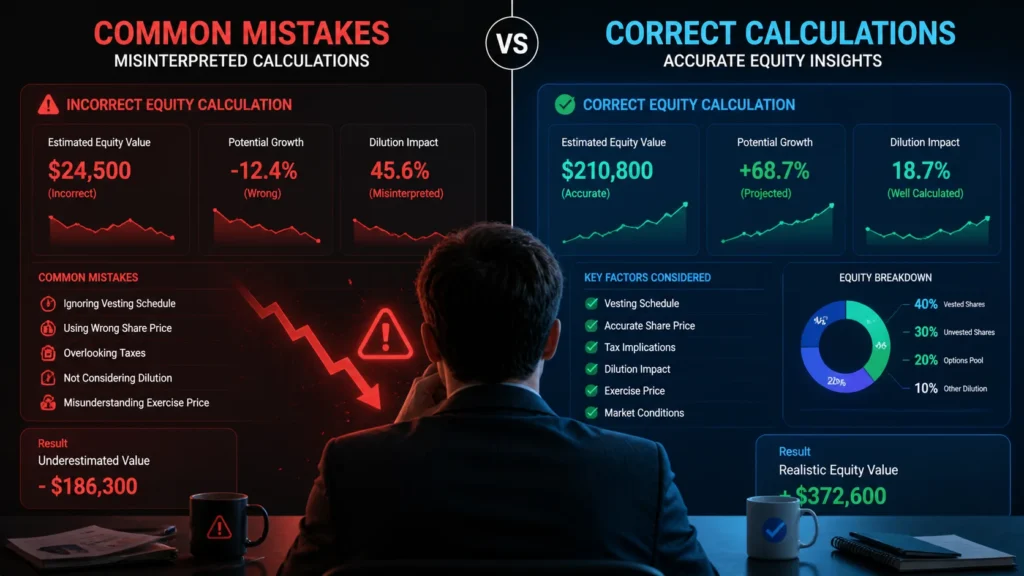
Common Mistakes & Misconceptions
ESPP: Sell Immediately vs. Hold for Qualifying Disposition
| Scenario | Holding Period | Tax Treatment | Effective Tax Rate | After-Tax Profit |
|---|---|---|---|---|
| Sell immediately after purchase | < 1 year from purchase | Ordinary income | 22% – 37% | ~$1,100 – $1,320 (on $2,000 discount) |
| Hold for qualifying disposition | 2 yrs from offer + 1 yr from purchase | Long-term cap gains | 0% – 20% | ~$1,600 – $2,000 (on $2,000 discount) |
| Disqualifying disposition | Sold before qualifying period | Ordinary income | 22% – 37% | ~$1,100 – $1,320 (on $2,000 discount) |
* Example assumes $25,000 ESPP contribution, 15% discount = $2,125 discount. Highlighted row = recommended strategy for most employees at stable public companies.
Most competitors skip this section entirely. Here’s what employees consistently get wrong when using a Share Incentive Plan Calculator or managing equity compensation:
How Much Tax Do You Pay on RSU Vesting?
RSUs are taxed as ordinary income at the time of vesting. The federal withholding rate is 22% for most employees. High earners in the 32–37% bracket owe more at filing. State tax adds on top — California employees pay up to 13.3% extra, pushing the combined rate above 45% in some cases.
| State | Combined Tax Rate | You Keep (on $25k vest) |
|---|---|---|
| California | 41–45% | ~$13,750 |
| New York | 47–50% | ~$12,500 |
| Texas | 22–24% | ~$19,000 |
| Florida | 22–24% | ~$19,000 |
| Illinois | 27–29% | ~$17,750 |
Mistake 1 — Ignoring State Taxes
Federal withholding on RSU vesting is 22% for most employees. But in California, state income tax adds up to 13.3%. In New York City, combined federal, state, and city taxes can exceed 50% on supplemental wages. Always enter the combined marginal tax rate — not just the federal rate into any Share Incentive Plan Calculator for an accurate post-tax projection.
Mistake 2 — Treating the Grant Value as Spendable Cash
An RSU grant of $100,000 over 4 years is NOT $100,000 in the bank. It’s a projection based on today’s stock price. By the time shares vest, the price may be higher or lower. The Share Incentive Plan Calculator is a planning tool not a guarantee.
Mistake 3 — Forgetting the Strike Price for Options
Stock options only generate value if the share price rises above the strike price. An employee with 1,000 options at a $50 strike price earns exactly $0 if the stock sits at $48 at exercise time. The Share Incentive Plan Calculator reflects this correctly but employees who just look at grant size miss this entirely.
Mistake 4 — Letting Vesting Dates Pass Without Action
RSUs vest and become ordinary income whether an employee sells or not. Employees who miss vesting dates, forget to set up brokerage accounts, or don’t establish a sell plan can face unexpected tax bills or worse, let options expire worthless within the 90-day post-termination exercise window.
Mistake 5 — Concentration Risk
No financial advisor would suggest holding 40% of a net worth in a single stock. Yet many employees accumulate large positions in employer stock across RSUs, options, and ESPP all in one company. If that company hits hard times, the employee loses both their job and their savings simultaneously.
When NOT to Rely Only on This Calculator
Honest tools are transparent about what they can’t do. A Calculator is exceptional for projections and planning but users should seek professional guidance in these situations:
Alternative Minimum Tax (AMT) on ISOs:
Incentive stock options (ISOs) can trigger AMT the Alternative Minimum Tax when exercised, even if no shares are sold. This is one of the most expensive surprises in equity compensation and requires a CPA or tax advisor who specializes in stock compensation, not just a calculator. For a full overview of how the IRS classifies statutory vs. nonstatutory options, see IRS Topic No. 427 – Stock Options.”
409A Valuations for Private Company Equity:
Employees at pre-IPO companies receive equity based on 409A valuations that may differ significantly from actual market value at liquidity. This can model growth scenarios, but estimating a private company’s future IPO or acquisition price is speculative.
Cross-State Tax Situations:
Employees who live in one state and work in another or who moved states during a vesting period face complex multi-state tax obligations that require professional tax advice, not just a Calculator.
Large Grant Decisions at Salary Negotiation:
Using this Plan Calculator to evaluate an equity offer is smart. Making a final decision to accept or decline a major job offer based solely on calculator output without consulting a financial advisor or compensation specialist is risky.
Section 83(b) Elections:
For restricted stock (not RSUs), employees can sometimes file a Section 83(b) election to pay tax at grant instead of at vesting. This is an irreversible election with significant tax implications that requires professional legal and financial advice.
Tips to Get the Most Accurate Results
Tip 1 — Use the Exact Numbers from Grant Documents
Every equity grant comes with paperwork that specifies grant date, number of shares, vesting schedule, and (for options) the strike price. Entering estimated figures produces estimated results. Using exact figures produces accurate projections.
Tip 2 — Run Three Growth Scenarios
Most financial planners suggest modeling conservative (5%), moderate (8%), and aggressive (15%) annual growth rates. This gives a realistic range rather than a single point estimate.
Tip 3 — Update the Calculator at Every Major Vesting Event
Equity values change as stock prices move. Recalculating with updated share prices before each major vesting event especially before a large vest that will generate a significant tax bill — helps employees stay ahead of surprises.
Tip 4 — Factor In the Full Tax Picture
Federal income tax, state income tax, Social Security (6.2% up to the 2026 wage base of $176,100), and Medicare (1.45% + 0.9% for high earners) all apply to RSU vesting income.
Tip 5 — Model the “Sell Immediately vs. Hold” Decision for ESPP
For ESPP participants, comparing immediate sale (disqualifying disposition) versus holding for the qualifying period often reveals a meaningful after-tax difference. Run both scenarios before making the decision.
Tip 6 — Coordinate with a 401(k) Strategy
Large RSU vesting events push taxable income higher sometimes past thresholds for Roth IRA contributions or favorable capital gains tax rates. Employees who max their 401(k) ($23,500 for 2026, or $31,000 if age 50+) before a large vest can reduce their effective tax rate on the equity income.
Frequently Asked Questions
What is a Share Incentive Plan Calculator and how does it work?
A Share Incentive Plan Calculator is a free online tool that estimates RSU, stock option, and ESPP values after taxes. Enter share price, shares granted, vesting period, growth rate, and tax rate to get year-by-year projections instantly. No signup required.
How accurate are these projections?
The results are as accurate as the inputs provided. The tool uses verified financial formulas (compound growth, tax withholding rates, option intrinsic value calculations) to generate projections. However, results are estimates — future stock prices cannot be guaranteed, and actual tax liability may vary based on individual circumstances. The tool should be used for planning and comparison purposes, not as a substitute for professional financial or tax advice.
Does this tool support both RSUs and stock options?
Yes. The calculator supports multiple equity types: RSUs, incentive stock options (ISOs), non-qualified stock options (NSOs), ESPPs, and performance shares. Each equity type uses a different calculation model, and users simply select their award type from the dropdown menu before entering their specific grant details.
What is the difference between RSUs and stock options in this calculator?
RSU projections show value equal to (Projected Share Price × Number of Vested Shares), since RSUs always carry value above zero. Stock option projections show value only when the projected price exceeds the strike price: (Projected Price – Strike Price) × Vested Options. Options can project zero value if the stock doesn’t grow enough, while RSUs maintain value as long as the company has positive stock value.
Are taxes included in the results?
Yes. The tool includes tax estimation for federal income tax withholding (22% standard supplemental rate, adjustable), state income tax, Social Security, and Medicare. For ESPP awards, it models both qualifying and disqualifying dispositions to show which holding strategy results in a lower tax burden. Users should consult a CPA for precise tax liability, especially in AMT situations.
How does vesting schedule affect the output?
The vesting schedule directly determines when equity value is recognized. A cliff vesting schedule (where all shares vest at once after 1-4 years) will show large projected values concentrated in one year. A graded vesting schedule (e.g., 25%/year over 4 years) spreads the value across multiple years, which often results in a smoother tax picture and is reflected accurately in the year-by-year output.
Is this tool free to use?
Yes, completely free. There are no accounts to create, no data stored, and no subscription fees. Users simply enter their equity grant details, click calculate, and receive instant projections. For deeper analysis particularly around tax strategy, ISO/AMT planning, or large grant decisions consulting a financial advisor is strongly recommended.
How This Article Was Created
This guide was developed using verified financial formulas sourced from the IRS Publication 525 (Taxable and Nontaxable Income), the U.S. Securities and Exchange Commission’s investor publications on employee equity plans, and equity compensation research from NASPP (National Association of Stock Plan Professionals). All tax rates, IRS contribution limits, and equity taxation rules reflect current 2026 guidelines. This article is intended for informational purposes only and does not constitute tax, legal, or investment advice. Readers with complex equity situations are encouraged to consult a licensed CPA or CFP.

A Share Incentive Plan Calculator shows your real equity value after taxes — not just the grant number on paper. Always model 3 scenarios: conservative (5%), moderate (8%), and aggressive (15%) growth to make smarter financial decisions.