Your offer letter just landed. The equity section says something about RSUs and stock options, and now you’re staring at numbers that could mean everything or nothing depending on choices you don’t fully understand yet.
This happens to thousands of employees every year. The terms look similar. Both involve company stock. Both come with vesting schedules. But the mechanics, the tax treatment, and the real-world financial impact are completely different. Getting them confused costs people real money.
This guide breaks down the key differences between RSUs and stock options including ISOs and NSOs so anyone reading an equity package can actually understand what they’re holding.
What are RSUs and stock options?
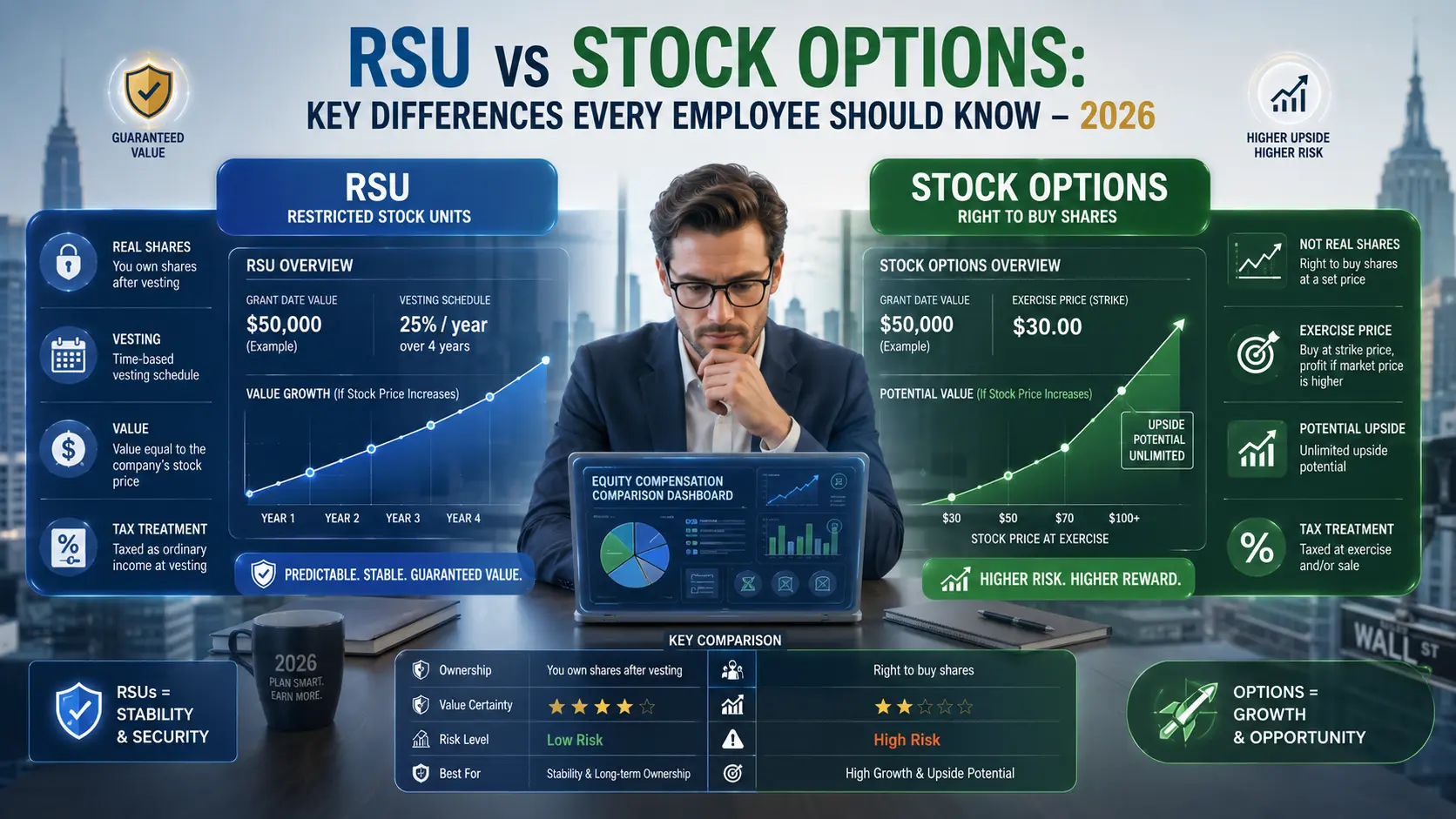
Restricted stock units (RSUs) are a company’s promise to give an employee actual shares after a vesting period ends. No purchase required. When RSUs vest, the shares land in the employee’s brokerage account and are taxed as ordinary income at that moment based on the fair market value of the stock on the vesting date.
Stock options work differently. A stock option gives the employee the right to buy shares at a fixed price called the exercise price (or strike price) set on the grant date. The employee pays that price to own the shares. If the stock has risen since the grant date, the employee profits from the spread. If it hasn’t, the options may be worthless.
There are 2 main types of stock options:
- Incentive stock options (ISOs): Only available to employees. Come with potential tax advantages if strict holding periods are met.
- Non-qualified stock options (NSOs): Can be granted to employees, contractors, and board members. No special tax treatment ordinary income tax applies at exercise.
Both RSUs and stock options are forms of equity compensation, but they reward employees differently, carry different risks, and create very different tax situations.
How to use an RSU vs stock options calculator
A good equity calculator helps an employee compare the projected value of RSUs versus stock options under different scenarios. Here’s how to use one effectively.
Step 1: Enter your grant details
For RSUs, enter the number of units granted and the current fair market value per share. For stock options, enter the number of options, the exercise price (strike price), and the current stock price.
Step 2: Set your vesting schedule
Most companies use a 4-year vesting schedule with a 1-year cliff. Enter the vesting period, cliff date, and any acceleration provisions if applicable.
Step 3: Input tax assumptions
Enter your federal income tax bracket, state tax rate, and Social Security/Medicare assumptions. This matters because RSUs and NSOs are taxed as ordinary income, while ISOs if held correctly may qualify for long-term capital gains rates.
Step 4: Run the scenarios
A good calculator lets users run multiple scenarios: stock price flat, stock price up 50%, stock price down 30%. This is where the real difference between RSUs and stock options shows up.
Worked example a software engineer in Austin, Texas:
Say a software engineer receives 2 offers:
- Offer A: 1,000 RSUs at $50 fair market value per share, vesting over 4 years
- Offer B: 4,000 stock options with a $50 strike price, vesting over 4 years
If the stock stays at $50 at vest:
- RSUs = $50,000 in value (taxed as ordinary income)
- Options = $0 (no gain over strike price, not worth exercising)
If the stock climbs to $80 at vest:
- RSUs = $80,000 in value
- Options = $30 spread × 4,000 = $120,000 in potential gain (before taxes)
If the stock drops to $35:
- RSUs = $35,000 in value (still worth something)
- Options = $0 (underwater strike price is higher than market price)
That worked example captures the core tradeoff: RSUs always have value; options have more upside but can expire worthless.
Understanding your results
Once a calculator runs those scenarios, here’s what the numbers actually mean.
RSU value at vest reflects the fair market value of shares delivered, which gets added to W-2 income for that year. The employer typically withholds taxes automatically often by selling a portion of the vesting shares to cover the bill.
Option spread is the difference between the exercise price and the current fair market value. For NSOs, that spread is taxed as ordinary income the year the employee exercises. For ISOs, the tax situation depends on the holding period.
Net value after tax is what actually lands in the employee’s pocket. This number varies significantly based on the employee’s total income, tax bracket, state of residence, and how long shares are held post-vesting or post-exercise.
Capital gains exposure kicks in after the initial tax event. Any appreciation in RSU shares after the vesting date, or any gain in stock option shares above the exercise price (for NSOs) or above fair market value at exercise (for ISOs), is subject to capital gains tax short-term if held under a year, long-term if held over a year.
RSU vs stock options: key differences at a glance
| Feature | RSUs | Stock Options (NSO/ISO) |
|---|---|---|
| Upfront cost | None | Must pay exercise price |
| Value if stock price drops | Still has value | Can go underwater (worthless) |
| Tax at grant | None | None |
| Tax event | At vesting (ordinary income) | At exercise (NSO: ordinary income; ISO: AMT consideration) |
| Tax after sale | Capital gains (short or long-term) | Capital gains (short or long-term) |
| Who can receive | Employees | NSOs: anyone; ISOs: employees only |
| Typical company stage | Public or late-stage | Startup / early-stage |
| Complexity | Low | Higher |
| Upside potential | Moderate (shares at market price) | High (if stock appreciates significantly) |
| Downside risk | Lower | Higher |
ISOs vs RSUs: the tax breakdown
Tax treatment is where ISOs and RSUs diverge most dramatically. Getting this wrong can mean a surprise tax bill worth tens of thousands of dollars.
RSU tax treatment:
When RSUs vest, the full fair market value of shares received counts as ordinary income. The employer reports this on the W-2 and withholds taxes accordingly. Say 500 RSUs vest when the stock is at $40 per share that’s $20,000 added to W-2 income, taxed at the employee’s marginal rate.
After vesting, any further gains are subject to capital gains tax. Sell within a year of vesting: short-term capital gains (ordinary income rates). Hold for more than a year before selling: long-term capital gains rates, which top out at 20% federally for most high earners.
ISO tax treatment:
No ordinary income tax at exercise that’s the ISO advantage. But the alternative minimum tax (AMT) may apply. The spread between the exercise price and the fair market value at exercise counts toward AMT income. For employees in certain income ranges, this creates a real tax liability even before the shares are sold.
To qualify for long-term capital gains treatment on ISOs, shares must be held for at least 2 years from the grant date and at least 1 year from the exercise date. Meet those requirements called a qualifying disposition and the entire gain from exercise price to sale price gets taxed at long-term capital gains rates. Miss them (a disqualifying disposition) and the spread gets taxed as ordinary income.
There’s also a $100,000 annual limit on the value of ISOs that can become exercisable in a single calendar year. Any amount above that is treated as an NSO.
NSO tax treatment:
The spread at exercise is ordinary income period. No holding period strategy changes that. After exercise, future appreciation is taxed as capital gains based on holding period.
RSU vs ISO vs NSO: side-by-side comparison
| RSU | ISO | NSO | |
|---|---|---|---|
| Taxed at grant | No | No | No |
| Taxed at exercise/vest | Yes ordinary income at vesting | AMT may apply at exercise | Yes ordinary income on spread |
| Favorable capital gains possible | Yes (on post-vest appreciation) | Yes (qualifying disposition) | Yes (on post-exercise appreciation only) |
| Available to non-employees | No | No | Yes |
| Requires 409A valuation | No | Yes | Yes |
| $100K annual vest cap | No | Yes | No |
| Exercise decision required | No | Yes | Yes |
| AMT risk | No | Yes | No |
| Post-termination window | Unvested forfeited; vested delivered | 90 days to exercise as ISO | Varies by plan |
Real-world use cases
1. The early startup employee in San Francisco
A product manager joins a Series A startup and receives 50,000 ISOs with a $2 strike price. Three years later, the company’s 409A valuation puts fair market value at $18. Exercising now means the spread is $16 per share that’s $800,000 in AMT income on paper. Exercising in smaller batches across tax years, or timing the exercise close to a liquidity event like an IPO, can help manage that AMT exposure. A tax professional familiar with equity compensation is not optional at this point.
2. The software engineer at a public tech company in Seattle
A software engineer gets 200 RSUs per year as part of their total comp at a public company. At each quarterly vest, the shares hit their brokerage account and taxes get withheld automatically. The question isn’t whether to exercise there’s no exercise decision. The question is whether to sell immediately, hold for long-term capital gains, or diversify. Given that company stock already represents a large chunk of their net worth, many financial advisors suggest selling a portion at vest to reduce concentration risk.
3. The contractor offered NSOs
A designer working as a contractor at a growth-stage startup gets 10,000 NSOs with a $5 strike price. ISOs aren’t available because they’re not a W-2 employee. When the company is acquired 2 years later at $22 per share, the designer exercises and immediately sells a $17 spread per share taxed as ordinary income. No AMT complications. No holding period required to get favorable treatment on the spread itself.
4. The mid-career employee choosing between offers
A data scientist in Austin gets 2 offers: one from a pre-IPO startup offering NSOs, one from a public company offering RSUs. The startup offer has a higher potential upside, but only if the stock price rises significantly above the strike price. The RSU offer has immediate, predictable value. Given the data scientist has a mortgage and limited appetite for illiquid equity risk, the RSU offer aligns better with their actual financial situation.
Common mistakes and misconceptions
Assuming options are always more valuable than RSUs
Options have more upside if the stock appreciates significantly. But RSUs always have value at vest. For employees at stable public companies, RSUs often deliver more reliable total compensation.
Forgetting about taxes at vest
RSUs trigger a tax bill the moment they vest, whether or not the employee sells the shares. Employees who don’t set aside cash for taxes or don’t understand that the company withholds automatically sometimes get blindsided. Always check what the actual after-tax number is.
Holding ISOs past the qualifying disposition period accidentally
Some employees sell ISO shares thinking they’re past the holding period, then discover they triggered a disqualifying disposition. The IRS requires 2 years from grant date AND 1 year from exercise date. Both clocks have to clear.
Ignoring the 409A valuation
For private company options, the exercise price gets set based on the 409A valuation an independent appraisal of fair market value. Employees sometimes assume the strike price reflects what the stock is “really” worth today. It’s a formal estimate, not a live market price.
Letting options expire after leaving a company
Most stock option plans give departing employees 90 days to exercise vested options after their last day. Miss that window options expire worthless. ISOs held past 90 days post-termination convert to NSOs and lose their favorable tax treatment.
Treating restricted stock awards (RSAs) and RSUs as the same thing
They’re not. RSAs involve actual share purchase (often at a nominal price) with a forfeiture condition. RSUs are a promise to deliver shares in the future. The 83(b) election applies to RSAs but not RSUs a consequential distinction.
When not to rely only on a calculator
A calculator gives projections based on assumptions. Real equity situations involve variables no calculator fully captures.
When AMT is a real concern: ISO exercises for high earners with significant spreads can trigger AMT liabilities that require modeling against an employee’s full tax picture. A tax professional with equity compensation experience is the right call, not a general-purpose calculator.
When the company is private: Valuation is uncertain. A 409A sets the exercise price, but what the company is actually worth — and what shares will be worth at a liquidity event is speculative. Calculators can’t model that uncertainty.
When state taxes are involved: California, for example, taxes long-term capital gains as ordinary income. New York, New Jersey, and other high-tax states have their own rules around equity compensation sourcing. A calculator using federal rates only can significantly understate the real tax bill.
When an employee holds a large concentrated position: Deciding whether to sell RSUs at vest, hold, or hedge a large position in a single stock involves risk management considerations that go well beyond tax math.
When equity is part of a divorce settlement or estate plan: These situations involve legal and tax complexities that require attorneys and CPAs, not calculators.
Tips to get the most accurate results
- Use the actual exercise price from the grant agreement, not an estimate
- Use current fair market value from the company’s latest 409A (for private) or today’s stock price (for public)
- Model multiple stock price scenarios — flat, up 50%, down 30%
- Enter the correct federal marginal tax rate based on total expected W-2 income for the year (not just the equity income)
- Add state income tax this changes the net number meaningfully for employees in California, New York, or New Jersey
- For ISOs: run the AMT calculation separately, or use a calculator that models AMT explicitly
- Check the post-termination exercise window in your grant agreement before making any job change decisions
- Confirm the vesting schedule cliff date, monthly vs. quarterly vesting before modeling future value
Frequently asked questions
Which is better, stock options or RSUs?
It depends on company stage and risk tolerance. Stock options offer more upside if the company’s stock price rises significantly above the strike price. RSUs always have value as long as the stock has any value at all. For employees at established public companies, RSUs are typically more reliable. For early startup employees betting on high growth, options especially ISOs can produce larger gains if things go well.
What is the difference between RSUs and stock options?
RSUs grant actual shares automatically after vesting, with no purchase required. Stock options give the employee the right to buy shares at a preset price. RSUs are taxed as ordinary income at vesting. Stock option tax treatment varies by type: NSOs trigger ordinary income tax at exercise; ISOs may qualify for capital gains treatment if holding period requirements are met.
Are RSUs taxed as ordinary income?
Yes. When RSUs vest, the fair market value of shares received is reported as W-2 income and taxed at the employee’s ordinary income tax rate. The employer typically withholds a portion of shares to cover federal and state taxes. Any appreciation in share value after the vest date is taxed as capital gains short-term if sold within a year, long-term if held longer.
What is the difference between RSUs and ISOs?
RSUs require no purchase and are taxed as ordinary income at vesting. ISOs require the employee to buy shares at the strike price and carry potential AMT exposure, but qualify for long-term capital gains treatment on the full gain if holding period requirements are met (2 years from grant, 1 year from exercise). ISOs can only be granted to employees, while RSUs can be granted to employees in both public and private companies.
What happens to RSUs and stock options when an employee leaves the company?
Unvested RSUs are forfeited upon termination in most cases. Vested RSUs are typically delivered or remain in the employee’s brokerage account. For stock options, most plans give departing employees 90 days to exercise vested options. ISOs not exercised within 90 days of termination convert to NSOs. Options not exercised within the post-termination window expire worthless.
What is a 409A valuation and why does it matter?
A 409A valuation is an independent third-party appraisal of a private company’s common stock fair market value. It’s required under IRS rules to set the exercise price for stock options. If options are granted below fair market value, the employee faces significant tax penalties under IRC Section 409A. For employees at private companies, the 409A valuation is the reference point for calculating the spread on options.
Can RSUs go underwater like stock options?
No. RSUs always have value as long as the stock price is above zero. Stock options go “underwater” when the market price falls below the strike price, making them worth nothing to exercise. This is one of the main reasons later-stage and public companies favor RSUs they provide more predictable retention value regardless of market conditions.
What is the cap table and how do RSUs and options affect it?
A cap table (capitalization table) tracks ownership of a company’s equity. RSUs and stock options both affect the cap table, but in different ways. RSUs convert to actual shares upon vesting, predictably increasing share count. Options affect the cap table only when exercised. Unexercised options are reflected as potential dilution but don’t create shares until the employee actually buys them.
Share your experience
Have you navigated an RSU or stock option decision at a startup, a public company, or during a job change? What surprised you most about how the taxes actually worked out?
Leave a comment below. Real experiences from employees who’ve been through this help others make better decisions.
How this article was created
This article draws on IRS guidance on equity compensation and stock options (IRS Publication 525 and IRC Section 422), publicly available tax analysis from CPAs and equity compensation specialists, and data from equity management platforms including Carta and J.P. Morgan Workplace Solutions. All tax treatment descriptions reflect current federal rules. State tax rules vary and are noted where relevant. Readers with specific equity decisions should consult a qualified tax professional or financial advisor before acting on any information here.